Sitka Project 2026
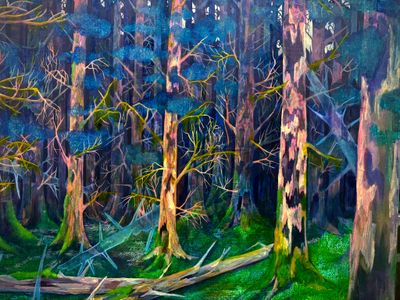
My practice explores landscape, place, and human relationships with the earth. This project upends romantic notions of nature, revealing the complex ecological networks inhabited by both human and more-than-human actors fighting for control. asking us: what do we consider a forest? My recent practice is situated within Sitka spruce (Picea sitchensis) plantations in Clare.
The Sitka spruce, native to the wet, temperate coasts of North America from northern California to Alaska, was introduced to Ireland in the late nineteenth century in order to provide fast-growing timber; commercial planting began in earnest in the twentieth century and it now accounts for more than half of the country’s forest estate (Coford, 2020). These cultivated forests have been criticised for creating dense, uniform canopies that with restrict light and create acidic soil outcompeting native tree species. Yet these environments are not without life; beneath the orderly surface, mosses and small mycelial networks of fungi form quiet habitats that complicate the distinction between what is natural and what is constructed.
Timothy Morton’s The Ecological Thought offers a framework for this ambiguity, noting that increased ecological knowledge both deepens connection and intensifies strangeness (Morton, 2010, p. 17). Morton suggests that wilderness functions as the unconscious of modern society, a space where the fantasy of untouched ‘Nature’ allows us to preserve the dream of separation and of human exceptionalism. The cultivated spruce forest becomes a site where this dream logic unravels; its ordered rows and dark understory expose how the aesthetics of ‘Nature’ can obscure the ecological realities of human design
Through psychogeographic mapping of the layout of these spaces and documenting my own interpretation through video, paint and instilation, I expose how their rigid layout reveals an uncanny authority over movement. The disorientation within the work is shaped by ecological systems and material conditions where one can perhaps hear the mechanical whir of a chainsaw in the distance. This uncanniness recalls what Mark Fisher describes as the eerie: an unease produced by “something where there should be nothing, or nothing where there should be something” (Fisher, 2016). In the cultivated forest, this sensation lingers. Many Sitka spruce treeshave fallen, their shallow root systems easily lifted by wind in the wet Irish climate.
These works examine how, beneath layers of control in this man-made forest, alternative dynamics of life and agency persist. Through these inquiries, this work explores how environmental awareness might have something inherently strange about it, as if we were seeing behind the mossy curtain. By inviting viewers to encounter both the staging and the play, these works open a provisional world in which agency can be reimagined. In these moments of confusion, the distinction between human and tree, observer and environment, begins to waver; perhaps, in this world of repetition and renewal, we are the trees.
Coford (2020) Forest Statistics Ireland 2020: A review of the state of Ireland’s forest resources. Dublin: COFORD. Available at: https://www.coford.ie/media/coford/content/publications/2020/35769COFORDbodyreportweb211220.pdf
Mark Fisher. (2016) The Weird and the Eerie. London: Repeater Books.
Morton, T. (2010) The Ecological Thought. Cambridge, MA: Harvard University Press.